The Before Times: The Citidome Prologue

Prior to releasing The Citidome to beta readers, I agonized for weeks over whether a prologue was necessary to include with the main body of the story. Not so much because prologues are apparently a taboo within genre fiction (I worried over that too), but more so because I didn't want to simply hand over the keys to the castle so to say. I appreciate it when authors don't spoon-feed information to their readers, which is why prologues have garnered such a bad rep I guess-- more often than not, they're just used as info dumps.
With that said, I couldn't squeeze in a worthy prologue. If I were to use one, I wanted it to be important within the context of the rest of the story, not just a bunch of background information. Don't get me wrong, I love background information. And there is oodles of it for The Citidome! But was it wholly important for the reader to get what was happening? Probably not.
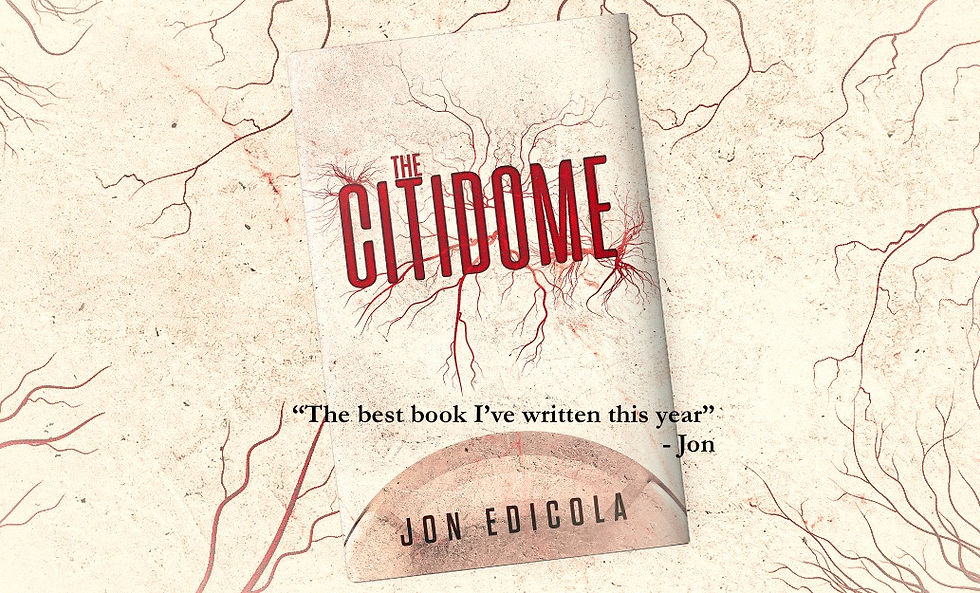
So I scrapped the idea. Not for lack of trying though. What follows is one of my better attempts (I think?) at what I thought would be pertinent info in the form of a prologue for The Citidome. Overall, I think it functioned more as a mood-setter than functional story material (which is why it ultimately got cut), but it's interesting to think back on this stuff now. Especially since we saw some of this play out in the real world with the whole pandemic situation. Hope you enjoy. And if you do find the setting intriguing, check out The Citidome on Amazon.
2021 A.D. - Northeastern Region, United States of America
Scientists and doctors in biohazard suits patrolled the length of the queue, their instruments quietly sampling the air and the occasional shoulder of one of the huddled persons waiting their turn. Impatient children clung to their parent’s hands, some staring intently at the scientists clad in their safety gear while others screeched at the sight of them. Every few minutes, the line would advance a few paces and halt again, the people within the procession collectively gathering their belongings and dropping them as they neared the end of their wait. Armed guards sat in cherry pickers coopted for use at the checkpoint. A tenuous order had been restored following panic earlier that morning. Ahead, a massive domed construct of glass loomed against the horizon, propped up on walls made of steel and concrete. The line’s terminus. A Citidome. An inverse quarantine facility where healthy people would seal themselves off from the environment until either the disease ran its course, or a cure was found. Humanity’s last chance.
The security checkpoints had been set up in anticipation of the evacuations. Evacuations mandated by a fraying government that people were hesitant to listen to since they weren’t certain who held power following the dissolution of the line of succession. News broadcasts played the evac message every thirty minutes, interspersing interviews with pedestrians from around the country that were either complying or boarding up their homes like a hurricane was approaching, stating they’d ride it out. Footage of families strapping their lives to the roofs of vehicles, or homes with particle board fortified windows spray painted with messages of “this too shall pass” and “trespassers will be shot” were sandwiched in between the interviews, apparently more interesting than the one-on-one of the reporters with interviewees. Every so often, a medical professional would join the news desk and explain what symptoms to monitor for—persistent cough with phlegmy discharge; patchy, discolored skin; eyes going yellow with jaundice or developing a red corneal ring. These people were instructed to shelter in place and quarantine themselves from human contact— the disease had been observed to pass as an airborne contagion.
Shortly after the outbreak began, a rolling tally graphic depicting the death toll became a regular fixture in the corner of the broadcasts. When the ticker crossed the 1,000 mark a breaking news segment followed, the photos of some of the victims flashing briefly before cutting back to business as usual. Meanwhile, the counter climbed in the corner of the screen. ‘Milestones’ were acknowledged along the way as the number of casualties rose. News anchors, initially stoic during these segments, grew increasingly distraught and visibly frightened as thousands turned into tens of thousands. Their warnings and pre-prepared messages deteriorated to pleading tones.
“If you haven’t evacuated to your regional Citidome, please…please do so now so that we can hope to slow the disease.”
After some time, the anchors and hosts no longer accompanied the segments, and the interviews began to loop. Eventually the evacuation message was the only thing being broadcast. Stations went dark shortly after.
Once television went and everyday services failed, the average citizen started to pay attention rather than ignore the “overhyped doomsday warning,” as one interviewee put it. When gas stations started hanging signs stating they were out of fuel and grocery stores remained shuttered, panic set in. Months of warnings heralded as entertainment by media suddenly became real. Panic forced action and the number of evacuees surging toward checkpoints swelled, crashing like tidal waves. Staffing issues slowed the clearance process, eventually forcing those in power to consolidate efforts to singular checkpoints. Lines only grew longer with each passing day. The evacuation process was structured around an orderly intake system that was meant to keep people from congregating en masse—a tactic that would hopefully prevent the disease from spreading like wildfire amongst those forced to wait. However, as the volume of evacuees increased, the nightmare was realized. Ancillary medical tents setup alongside checkpoints separated the infected from the general population, but quickly filled to capacity, the disease spilling over into the columns of people awaiting escape into the Citidomes.
No one was sure where the order came from, but it was passed through the chain of command, so it must have been official. The checkpoints were being shut down. Any who weren’t already in screening or being ushered into the Citidomes would not be processed. The doors were being closed. At 2100 hours, they would be shutout and left to fend for themselves. That day would go down in history as E-Day. The day the Citidomes sealed out the world.
[Book start with “20 years later”]


Comments